
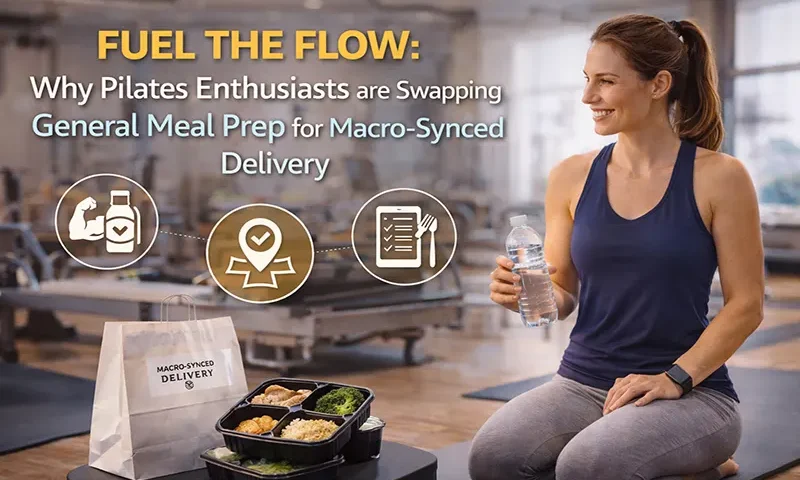
In the world of modern wellness, the phrase “abs are made in the kitchen” has been updated for the 2025 landscape. For the dedicated Pilates enthusiast—someone who understands that strength is built through precision, controlled breath, and microscopic muscle engagement—the kitchen has become a laboratory for performance.
For years, the gold standard of healthy living was “meal prep.” We spent our Sundays poaching flavorless chicken breasts and steaming broccoli into mush, all in the name of “eating clean.” But as the Pilates method continues to evolve into a high-performance lifestyle, general meal prep is no longer making the cut. Instead, a new trend is taking over reformer studios from Los Angeles to London: Macro-Synced Delivery.
The Pilates Paradox: Strength Without Bulk
To understand why general meal prep is failing this community, we must first look at the unique physiological demands of Pilates. Unlike heavy bodybuilding, which requires a massive caloric surplus and high protein loads to build “bulk,” or pure cardio, which demands high glycogen stores, Pilates requires a delicate balance.
Pilates practitioners seek “long, lean muscle,” core stability, and high levels of flexibility. This requires a specific macronutrient ratio—enough protein for muscle repair (the “lean” factor), complex carbohydrates for sustained energy without the “crash,” and healthy fats to support joint health and hormonal balance. General meal prep often misses the mark, either providing too many calories that lead to sluggishness or too few, leading to muscle fatigue during that grueling “hundreds” series.
The Problem with “General” Healthy Eating
The issue with standard healthy meal prep is that it is designed for the “average” person. A standard healthy meal prep kit might contain 500 calories with a generic split of 30g protein, 50g carbs, and 15g fat. While this is objectively “healthy,” it isn’t synced.
For a Pilates enthusiast, the timing and the “why” behind the nutrients matter. Macro-syncing takes the guesswork out of the equation by aligning the meal’s composition with the specific metabolic needs of low-impact, high-intensity resistance training. When you are swapping general prep for synced delivery, you aren’t just eating food; you are administering a biological fuel specifically designed to enhance “the flow.”
1. Precision Recovery: Beyond Just Protein
We’ve been conditioned to think that more protein always equals better recovery. However, the Pilates body thrives on bioavailability. Macro-synced delivery services often focus on high-quality, anti-inflammatory proteins—like wild-caught salmon, organic tempeh, or grass-fed collagen-rich broths—that repair the deep stabilizers (like the transverse abdominis) without causing the digestive bloat associated with heavy whey shakes or red meat.
These services understand that a Pilates session creates “micro-tears” in a different way than a heavy squat session does. The recovery needs to be as precise as the movement. By syncing macros, these meals provide the exact amino acid profile needed to maintain muscle tone while keeping the body feeling light and agile.
2. Eliminating the “Bloat Factor”
There is nothing more distracting during a Pilates class than a bloated core. Because the practice focuses so heavily on “scooping” the navel to the spine and maintaining a tight midsection, digestive comfort is a performance requirement.
General meal prep often relies on “fillers” or high-fiber vegetables that, while healthy, can cause significant bloating if not prepared correctly (think raw kale or un-soaked legumes). Macro-synced delivery services specializing in the “flow” lifestyle prioritize gut health. They utilize fermentation, sprouted grains, and cooked-down cruciferous vegetables to ensure that the athlete is fueled but their stomach remains flat and comfortable for their afternoon session.
3. The Mental Load: Decision Fatigue is a Performance Killer
The modern Pilates enthusiast is often a high-achiever—a “busy professional” or a “multitasking parent” who values efficiency. Spending four hours on a Sunday chopping vegetables is a form of labor that detracts from their wellness.
Macro-synced delivery removes the “Mental Load.” When your meals are pre-calculated to fit your specific biometric needs, you reclaim hours of your week. This mental clarity allows for a deeper “mind-body connection” during class. You aren’t wondering what you’ll cook for dinner while you’re holding a plank; you already know that a chef-prepared, macro-balanced meal is waiting in your fridge.
4. Sustained Energy vs. The Glycemic Rollercoaster
General meal prep often leans too heavily on simple grains like white rice or pasta because they are easy to bulk-cook. This leads to a spike in blood sugar followed by a crash—the enemy of a focused Pilates practice.
Macro-synced delivery services utilize complex, slow-burning carbohydrates like black rice, quinoa, or roasted sweet potatoes. By pairing these with fiber and healthy fats, they create a “blunted” glucose response. This means you have a steady stream of energy from the first footwork exercise to the final stretch, without the lightheadedness that often plagues practitioners in a fasted or poorly-fueled state.
The Evolution of the “Wellness Kit”
In 2025, your “Pilates kit” is more than just a pair of grip socks and a high-end mat; it includes your nutrition. We are seeing a rise in “Studio-to-Table” partnerships, where boutique Pilates studios are collaborating with delivery services to create custom menus.
This level of integration is the future of the culinary business. It recognizes that fitness and nutrition are not two separate silos, but a singular, continuous loop. If the movement is precise, the fuel must be equally precise.
Why “Good Enough” is No Longer Enough
As we become more educated about our own biology, the “general” approach to health is fading. We track our sleep with rings, our steps with watches, and our heart rate with straps. It only makes sense that we move away from “general” meal prep toward something as calculated as our wearable data.
Pilates enthusiasts are leading this charge because their practice demands a high level of bodily awareness. When you spend an hour focusing on the alignment of your ribcage and the engagement of your pelvic floor, you become hyper-aware of how your food affects your performance. You can feel the difference between a meal that was “just healthy” and a meal that was “synced.”
Conclusion: Investing in Your Infrastructure
Swapping general meal prep for macro-synced delivery is an investment in your physical infrastructure. It is an acknowledgment that your time is valuable and your goals are specific. By choosing nutrition that is designed for the “flow,” you are ensuring that every minute you spend on the reformer is backed by the highest quality fuel available.
In the end, Pilates is about the pursuit of balance—and there is no better way to find that balance than by aligning your plate with your practice.

