
The strength of U.S. leadership in technology rests on the ability to secure the foundations of computing. Chips, servers, and compute infrastructure are more than technical components, but the arteries through which economic vitality, military readiness, and scientific progress flow. As global competition intensifies, the United States faces a critical choice of either safeguarding its semiconductor and compute capacity or risking losing its competitive edge to rivals who are investing aggressively. Erik Hosler, a strategist in emerging technologies, underscores that resilience in this arena is not optional but essential. His framing highlights how the path forward requires both policy vision and industrial coordination to maintain national advantage.
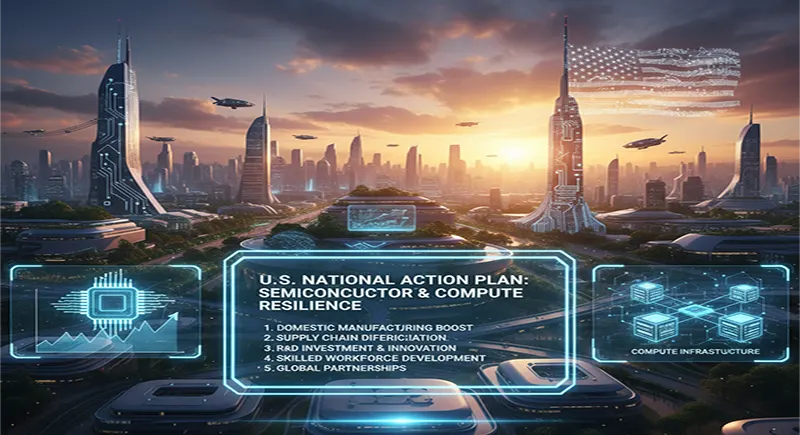
The National Action Plan for U.S. Advantage in Advanced Compute and Microelectronics, developed by the Special Competitive Studies Project (SCSP), offers a roadmap to meet this moment. Its strategic recommendations aim to fortify domestic capacity, ensure supply chain security, and accelerate the development of emerging technologies such as quantum and AI. While the document lays out ambitious goals, the real test will be in execution. The following analysis explores the key priorities that define the plan, showing why semiconductor resilience is central to U.S. competitiveness.
Securing the Semiconductor Supply Chain
At the heart of the plan lies a simple truth that the U.S. cannot rely on fragile global supply chains for critical technology. Over 90% of the world’s most advanced chips are manufactured in Taiwan, a geopolitical flashpoint that introduces immediate risk. Disruptions, whether from natural disaster or geopolitical tension, could send shockwaves across every sector of the U.S. economy.
The action plan calls for diversification and reshoring production. It means not only building advanced fabs on U.S. soil but also forging partnerships with trusted allies to distribute risk. While legislation such as the CHIPS and Science Act provides funding, the challenge lies in turning capital into sustainable capacity. Building domestic capacity requires incentives, infrastructure, and a skilled workforce, which is a combination that demands long-term commitment. Without this foundation, America’s innovation engine is vulnerable to forces beyond its control.
Supply chain resilience also extends beyond fabs. Materials, photolithography equipment, and packaging technologies form choke points where the U.S. remains dependent on overseas suppliers. The action plan stresses that securing the upstream and downstream components of the chip ecosystem is as critical as manufacturing itself. A chain is only as strong as its weakest link, and in semiconductors, those links span multiple industries and continents.
Investing in Advanced Compute Infrastructure
Resilience is not only about chips but also about the computational ecosystems they enable. The plan emphasizes investment in high-performance computing systems that power research, defense modeling, and AI development. These systems require vast amounts of processing capacity and energy-efficient designs to sustain growth.
Strategic investment in advanced compute facilities ensures that the U.S. can process the data needed for breakthroughs in science and national security. From climate simulations to cryptography, the demands of the future cannot be met with yesterday’s infrastructure. AI requires dedicated compute clusters to handle training and inference at scale. Without them, innovation slows, and reliance on foreign cloud providers grows.
Building resilient compute resources positions the U.S. not just to maintain parity but to lead in the technologies that will define the coming decades. The action plan emphasizes energy efficiency, sustainability, and cybersecurity as critical factors, recognizing that compute resilience is not simply about raw power but about reliability, trust, and long-term scalability.
The Workforce Challenge
A resilient semiconductor and compute ecosystem cannot exist without skilled talent. The action plan underscores the need to cultivate expertise across design, manufacturing, and maintenance. Shortages in semiconductor engineers, technicians, and materials scientists threaten to slow progress even as investment dollars flow into new facilities.
Developing this workforce requires rethinking education pipelines. From STEM education in early schooling to vocational training and advanced research programs, the U.S. must create clear pathways into the semiconductor industry. Scholarships, apprenticeships, and public-private partnerships are highlighted as mechanisms to bridge the talent gap. Global competitors, particularly in East Asia, have long recognized that talent is as critical as capital. Without addressing the workforce gap, even the best policies and investments will fall short.
The workforce issue is not only about numbers but also about specialization. Lithography engineers, cryogenic specialists, and packaging experts are in particularly short supply. Resilience demands depth across these niches, ensuring that the U.S. does not trade one form of dependency for another.
Innovation Across Multiple Sectors
Technology leadership is not secured by incremental improvements alone. Erik Hosler notes, “It’s going to involve innovation across multiple different sectors.” His perspective highlights that resilience is not confined to fabs or labs, but it must extend into materials, energy, software, and design tools. The semiconductor ecosystem is interconnected, relying on breakthroughs in photonics, manufacturing equipment, and even cybersecurity to sustain momentum.
The action plan calls for cross-sector innovation to ensure that bottlenecks in one area do not stall the entire system. Whether through public-private partnerships or research consortia, the United States must cultivate an environment where ideas can move rapidly from concept to deployment. It also includes leveraging strengths in software, where the U.S. has a global edge, to complement hardware advances. In a world where adversaries coordinate across industries, resilience requires the U.S. to match that breadth of innovation.
A Roadmap That Requires Action
The National Action Plan lays out ambitious goals, but the value of a roadmap lies in its implementation. Building fabs takes years, supply chains require trust, and workforce development demands long-term investment. If the U.S. delays, rivals will seize the initiative. If it acts decisively, the nation can secure not just technological capacity but the strategic leverage that comes with it.
Resilience in semiconductors and compute is not about insulating the U.S. from the world. It is about ensuring that America has the capacity, flexibility, and partnerships to navigate uncertainty without sacrificing its leadership. The plan is a call to act now because hesitation is itself a risk in the contest for competitiveness. Its goals are ambitious, but they are also necessary. As the technological battleground sharpens, resilience will define whether the U.S. remains a leader or becomes a follower in the industries that shape the century ahead.

